Seoul Travel Guide
Contents
- Seoul — Ancient Kingdom, Hyper-Modern Metropolis
- Seoul and Its Antipode
- The City
- Top Things to Do in Seoul
- Do and See
- Dining in Seoul
- Cafés in Seoul
- Bars & Nightlife
- Shopping
- Tourist Information
Seoul — Ancient Kingdom, Hyper-Modern Metropolis
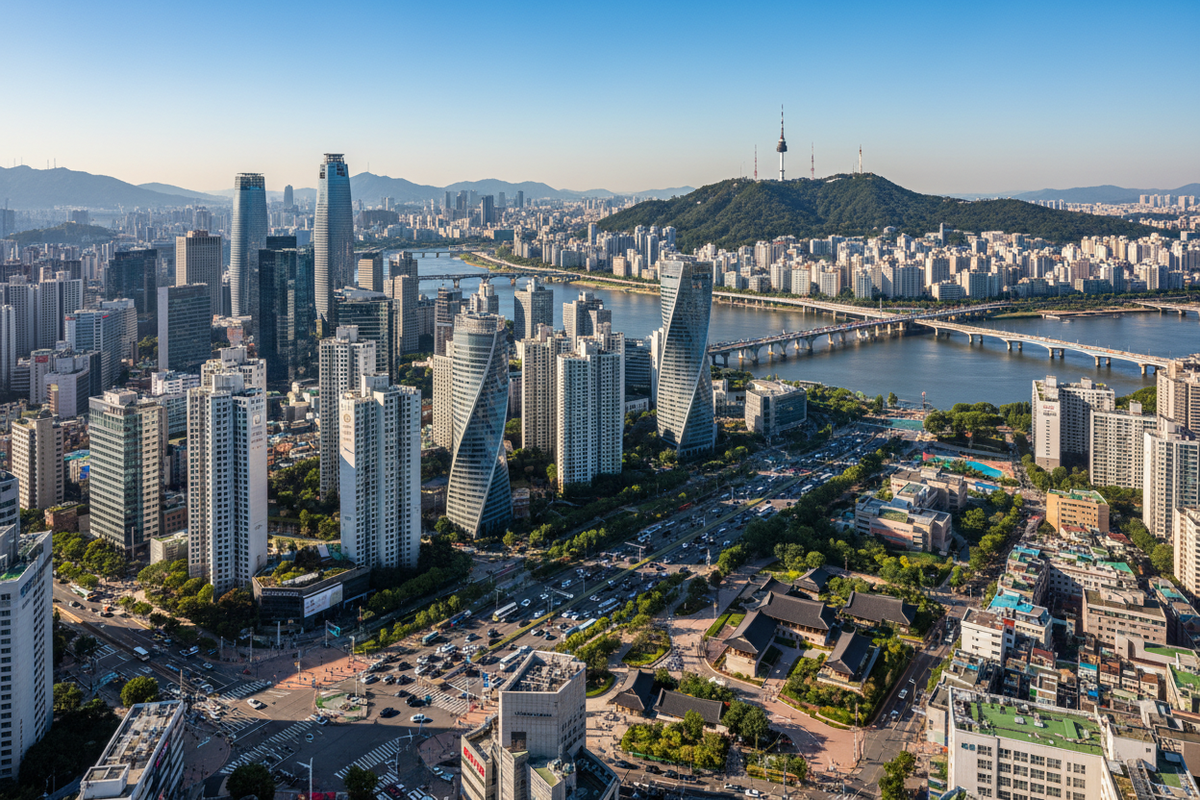
Seoul is a city of striking contrasts, where royal palaces and centuries-old neighbourhoods exist alongside some of the most advanced urban infrastructure in the world. As the capital of South Korea, Seoul has been continuously inhabited for over 2,000 years, serving as the political, cultural, and economic heart of the Korean Peninsula.
Mountains encircle the city, while the Han River cuts through its centre, shaping both its physical layout and daily rhythm. Seoul’s identity emerges from this balance between nature, tradition, and relentless modernisation.
Seoul and Its Antipode
Every place on Earth has an antipode — the point directly opposite it on the globe, connected by a straight line passing through the Earth’s core.
Seoul’s antipode lies deep in the South Atlantic Ocean, far from any major landmass. This land-to-ocean antipode mirrors Seoul’s orientation toward movement, trade, and exchange rather than geographic isolation.
The contrast between one of the world’s largest megacities and open ocean on the far side of the planet underscores Seoul’s role as a dynamic connector between East Asia and the wider world.
The City
Seoul is organised around distinct districts that reflect its layered history. Jongno and Insadong preserve royal palaces, temples, and traditional hanok architecture, while Gangnam and Yeouido represent modern commercial power. Itaewon serves as an international crossroads, and Hongdae pulses with youth culture, art, and nightlife.
Despite its scale, Seoul remains highly liveable, supported by one of the world’s most efficient public transport systems and extensive green spaces woven throughout the city.
Top Things to Do in Seoul
Gyeongbokgung Palace
The largest and most important of Seoul’s five royal palaces, built in 1395 during the Joseon Dynasty.
National Folk Museum of Korea
Located within the palace grounds, this museum explores Korean cultural history and traditional lifestyles.
Namsangol Hanok Village
A restored village showcasing traditional Korean houses, performances, and cultural activities.
N Seoul Tower
A city landmark offering panoramic views over Seoul from Mount Namsan.
Hangang River Ferry Cruise
A relaxed way to see Seoul’s skyline from the water, especially popular in the evening.
Bukhansan National Park
A mountainous park with hiking trails, granite peaks, temples, and forested valleys.
Lotte World
A major indoor and outdoor amusement park located within the city.
COEX Aquarium
A large marine attraction beneath COEX Mall, popular with families.
Bongeunsa Temple
An ancient Buddhist temple located in the heart of Gangnam.
Changdeokgung Palace
A UNESCO World Heritage site known for its harmonious integration with natural surroundings.
The War Memorial of Korea
A comprehensive museum dedicated to Korea’s military history.
National Museum of Korea
One of Asia’s largest museums, housing artefacts from prehistoric to modern Korea.
Dongdaemun Design Plaza
A futuristic landmark combining design exhibitions, shopping, and public space.
Cheonggyecheon Stream
An urban restoration project transforming a former highway into a 10-kilometre riverside park.
Do and See
Namsan Park
A central green space offering walking paths and city views.
Seoullo 7017 Skygarden
An elevated pedestrian park created from a former highway overpass.
Yeouido Hangang Park
A riverside park popular for festivals, picnics, and cycling.
Seoul Olympic Park
A legacy of the 1988 Olympic Games featuring sports venues and green space.
Leeum Samsung Museum of Art
A museum combining traditional Korean art with contemporary international works.
Trickeye Museum
An interactive museum using optical illusion art.
Dining in Seoul
Seoul’s food scene ranges from humble street stalls to refined fine dining. Traditional Korean dishes such as bibimbap, bulgogi, kimchi, and Korean barbecue are central, accompanied by a wide array of international cuisines.
- Mugyodong Bugeokukjib
- Ondal
- Samwon Garden
- Philkyungjae
- Myeongdong Kyoja
- Jung Sik Dang
- Pro Soy Crab
Cafés in Seoul
Seoul is famous for its café culture, from historic coffee houses to themed cafés and modern specialty roasters.
- Passion 5
- O’Sulloc Tea House
- Hakrim Dabang
- Seoureseo Duljjaero Jalhaneunjip
- Casablanca Sandwicherie
Bars & Nightlife
Nightlife in Seoul is neighbourhood-driven, with Hongdae, Gangnam, and Itaewon each offering distinct atmospheres.
- Club Octagon
- M2 The Club
- Living Room
- J.J. Mahoney’s
- Club FF
- Lobby Lounge Bar
Shopping
Seoul is one of Asia’s premier shopping destinations, offering everything from traditional markets to luxury malls.
- Namdaemun Market
- Dongdaemun Market
- Myeongdong
- Itaewon
- Insadong
- COEX Mall
- Yongsan Electronics Market
- Gwangjang Market
Tourist Information
Seoul is served by Incheon International Airport, located approximately one hour from the city centre.
Public transport is extensive and efficient, including subways, buses, taxis, and river ferries. Signage is widely available in English.
The best time to visit Seoul is spring (April–June) and autumn (September–November), when temperatures are mild.
Electricity in South Korea is 110V and 220V / 60 Hz using round two-pin plugs.
