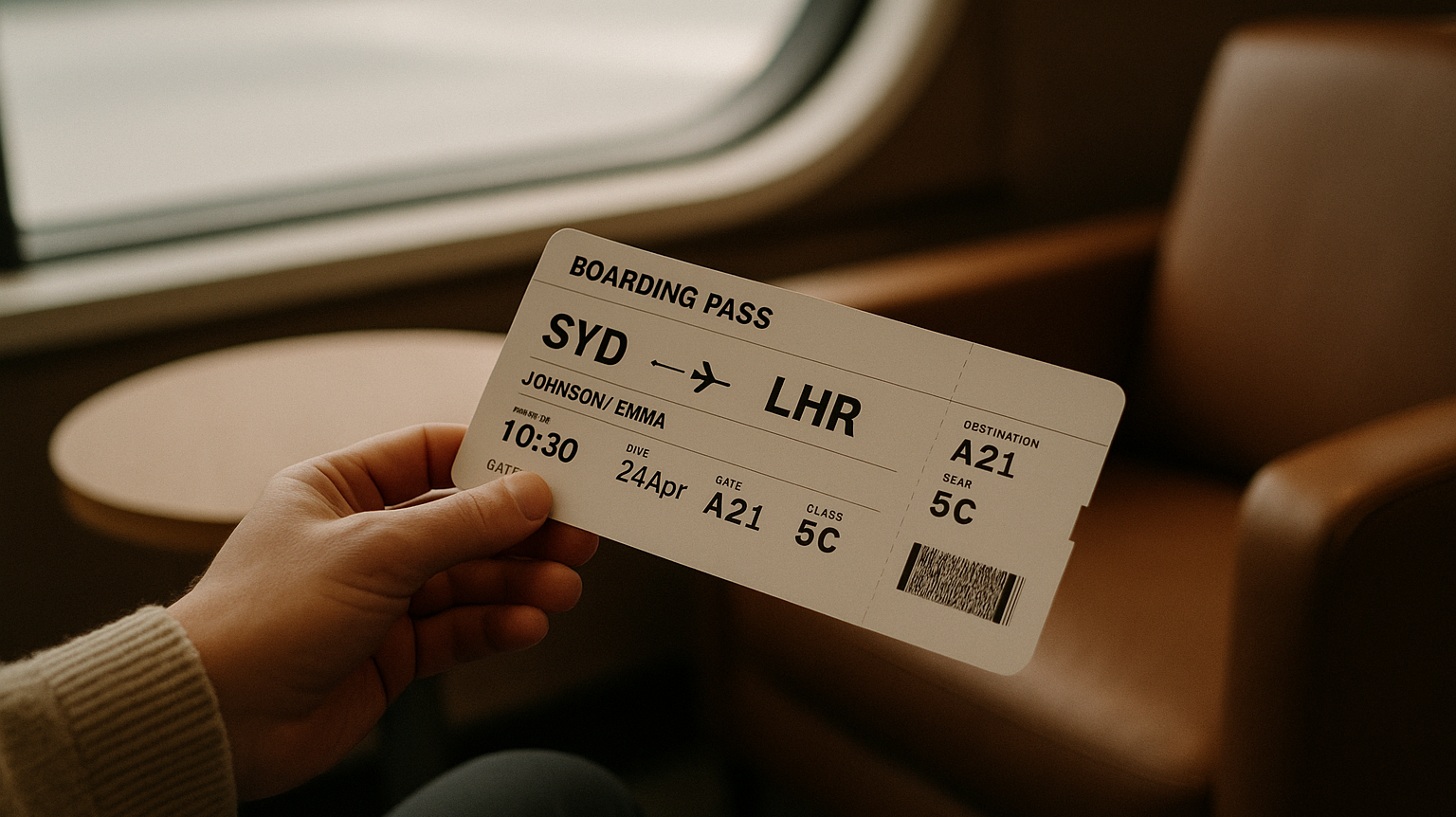
The Story of the Boarding Pass
How a slip of paper became a symbol of movement, identity, and the ritual of modern travel.
Before travel apps, QR codes, and digital wallets, there was the boarding pass — a small rectangle of paper that carried with it the promise of departure. Folded into pockets, slipped into passports, clipped to bags, it was the one physical object every journey had in common.
Part document, part souvenir, part ritual.
The boarding pass became a quiet cultural icon — something travellers held, read, and kept long after the flight was over.
In a world moving rapidly toward the digital, its story is worth slowing down for.
A Ticket to the Sky
The early boarding pass was an extension of the ticket itself.
Handwritten. Stamped. Checked by gate agents who relied on touch more than scanners.
As commercial aviation grew in the mid-20th century, airlines began standardising their documents. By the 1960s, boarding passes had adopted a familiar structure: name, seat, gate, flight number — information printed not just for utility, but for clarity.
They were small, durable, and personal.
And for many travellers, they were often the first physical sign that the journey had begun.
Design in the Service of Movement
The boarding pass became a quiet canvas for branding.
Airlines experimented with:
-
typefaces
-
colours
-
layout systems
-
graphic codes
-
national identity motifs
SAS used crisp Scandinavian grids.
Japan Airlines leaned into soft minimalism.
Pan Am embraced bold blue, the colour of horizons and hemispheres.
Each pass looked subtly different — a pocket-sized expression of the airline itself.
These design choices weren’t aesthetic indulgence; they were functional.
Clarity mattered.
Legibility mattered.
Mistakes had consequences.
A good boarding pass was one you could read at a glance, in a hurry, half-asleep at 5:45 AM.
The Romance of Paper
There was a small pleasure in the ritual:
-
printing the boarding pass
-
holding it between your fingers
-
folding it once, twice, neatly
-
sliding it into a passport
-
handing it over at the gate
It marked the threshold between where you were and where you were going.
A tactile checkpoint.
A physical affirmation of the decision to depart.
For some, it became a keepsake — a way to bookmark a moment in life.
A first solo trip.
A long-haul escape.
A love story that began with a departure gate.
The boarding pass made travel feel real in a way digital screens rarely do.
The Digital Shift
Today, the boarding pass is transforming.
What was once a slip of paper is now:
-
a barcode on a lock screen
-
a square in a wallet app
-
a flicker of light on a smartwatch
Convenience has replaced tactility.
Speed has softened the ritual.
And yet, something lingers.
Even with digital passes, travellers still screenshot them, zoom in, re-check details — echoing old habits that refuse to fade.
We still crave the reassurance the original object offered.
Why the Boarding Pass Still Matters
Even in its digital form, the boarding pass remains symbolic.
It represents:
-
permission
-
movement
-
identity
-
transition
-
possibility
It marks the moment between the familiar and the unknown.
Whether printed on thick cardstock or rendered as pixels, the boarding pass is a simple message:
You are leaving.
You are going somewhere.
Your life will be slightly different when you land.
In its small way, it carries the emotional weight of travel better than almost any other object.
A Final Note
The boarding pass may one day disappear entirely, replaced by biometrics and frictionless identity systems. But its story — of ritual, design, and anticipation — will remain part of the culture of flying.
It was never just a ticket.
It was a moment.
And moments, even small ones, matter.